COP30: Wins for mental health but more ambitious climate action needed
COP30 in Belém concluded with mixed results, failing on major agreements on transitioning away from fossil fuels, yet securing vital wins for mental health recognition within climate policy. The conference succeeded in giving an unprecedented platform to Indigenous communities. This outcome highlights the powerful, necessary convergence of the global health community and climate advocacy. Read on to find out more.
By Alessandro Massazza, Senior Policy & Advocacy Advisor, United for Global Mental Health
28th November, 2025
Last week, COP30 concluded in Belém, the gateway to the Amazon forest in Brazil. Despite incremental advances in the negotiations, especially in the areas of just transition and adaptation, some of the big ticketed items for COP30 failed to materialize. However, some important wins were achieved for mental health and the climate and health community was strongly represented and clearly called for ambitious climate action to protect health from the impacts of climate change.
Additionally, COP30 marked an unprecedented effort to include the voices of communities traditionally excluded from high-level climate discussions, such as Indigenous communities, which often bear the brunt of the mental health impacts of climate change. For a detailed run through of all COP30 outcomes see here and here.
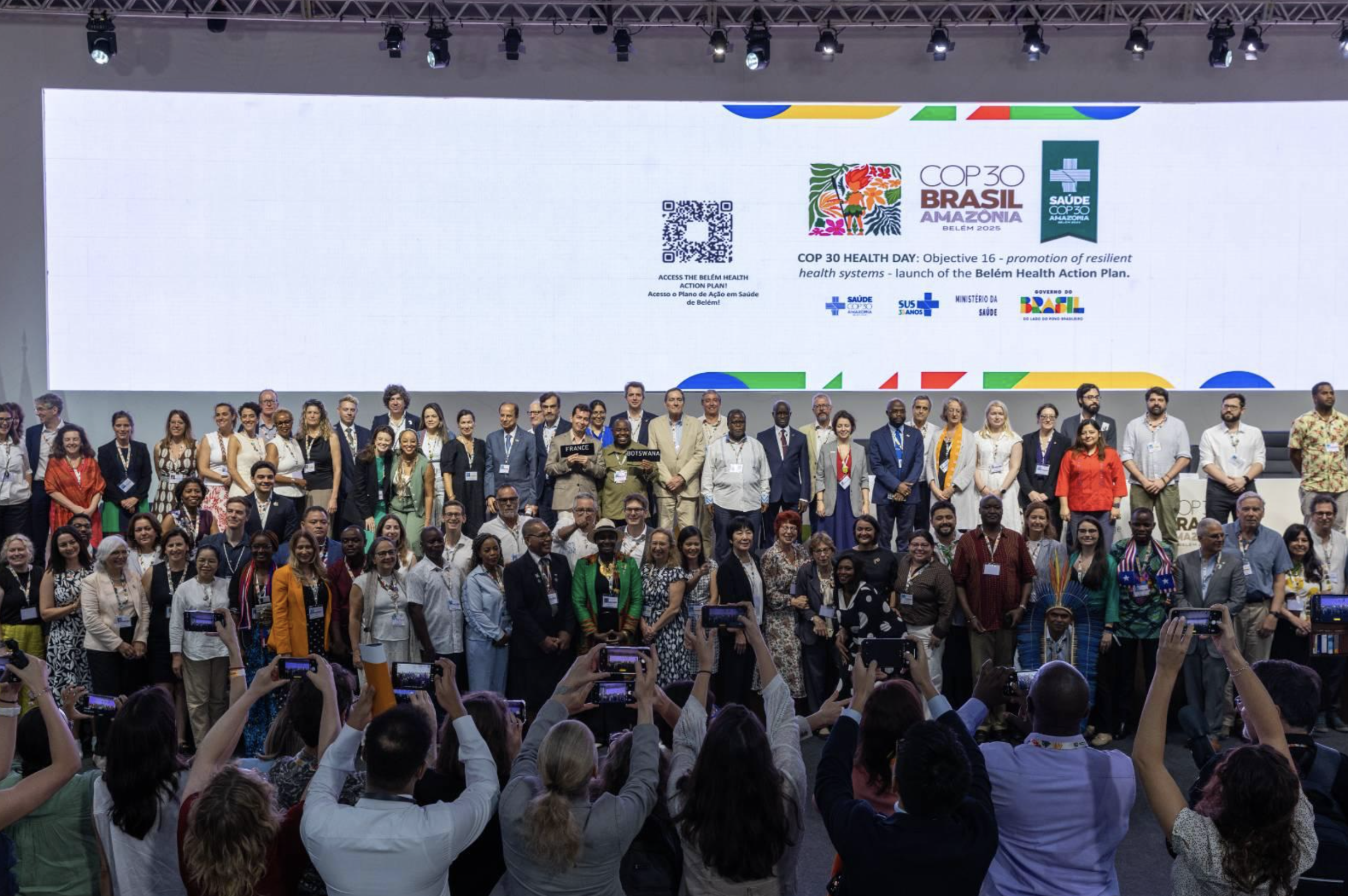 The endorsers of the Belém Health Action Plan for the Adaptation of the Health Sector to Climate Change during the Ministerial Meeting on Health Day at COP30 in Belém, Brazil
What are the key outcomes from COP, and what do they mean for mental health?
Adaptation
Around the world, the impacts of climate change are being increasingly felt by people and communities. Adaptation action is therefore needed to ensure that resilience is strengthened and people are protected from the worst impacts of climate change, including its mental health impacts. At COP30, three key outcomes were achieved when it comes to adaptation and health:
(i) A key task for negotiations at COP30 was reaching an agreement on the Global Goal on Adaptation, an instrument with its roots in the Paris Agreement, aimed to track global progress on climate adaptation. A list of around 100 indicators had been proposed by 78 experts to measure progress on 11 targets, including an indicator on mental health. We strongly advocated in the lead-up to COP30 to ensure that the mental health indicator would be protected during the negotiations.
At COP30, negotiators adopted a set of 59 indicators (see agreed text here) and most of the health indicators were maintained and we are celebrating the inclusion of a mental health indicator (“Proportion of the population vulnerable to climate change with access to mental health and psychosocial support”). This represents the first time ever that mental health is formally included within a negotiated outcome text so centrally, highlighting the importance of ensuring that the mental health of people and communities is protected from the impacts of climate change.
However, some countries criticized changes in the original indicator list made by the Presidency which made some of the indicators technically challenging to measure. Future refinement work has therefore been planned as part of a two-year “Belém-Addis vision” process, with work starting at the next Bonn intersessional in June 2026.
(ii) While agreement on indicators is an important step; countries’ ability to measure and track these ultimately relies on the availability of adaptation finance. With the 2021 COP26 pledge to double adaptation finance from 2019 levels expiring this year, this COP30 was a key moment to raise ambition on adaptation finance. COP30’s mutirão text concluded with a new target of at least tripling adaptation finance by 2035 and urged developed countries to increase the trajectory of their collective provision of climate finance for adaptation to developing countries.
This represents an essential step to ensure that countries most impacted by climate change have the financial resources to protect themselves as mental health cannot be safeguarded from the impacts of climate change unless climate action is appropriately financed. However, the 2035 timeline has been criticized as being too far in time and the lack of a clear baseline may make the target ambiguous.
(iii) One of the key initiatives within the Action Agenda presented by the Brazilian Ministry of Health together with the World Health Organization and the Pan-American Health Organisation has been the Belém Health Action Plan for the Adaptation of the Health Sector to Climate Change. The Action Plan includes a specific section (section 2.3) on mental health and represents the first time that an official COP output includes concrete actions on how to integrate mental health into climate adaptation.
These actions range from integrating mental health and psychosocial support (MHPSS) into national climate and health policies to strengthening mental health systems to respond to the impacts of climate change. Importantly, a Climate and Health Funders Coalition bringing together more than 35 philanthropies was established and committed an initial $300 million to support the implementation of the Belém Health Action Plan.
Just transition
As countries transition away from fossil fuels, it’s essential that this transition happens in a fair and just manner that protects the physical and mental health of workers and communities. This was explicitly recognized in the final negotiated text on just transition which highlighted that countries should, when taking actions to address climate change, respect the rights to a healthy, clean, and sustainable environment as well as the right to health. Additionally one of the key victories celebrated at COP30 has been the adoption of a process to develop a “just transition mechanism” to enhance international cooperation, technical assistance, capacity-building and knowledge sharing, and enable equitable, inclusive just transitions.
Fossil fuels and mitigation
COP30 took place in the wake of a sobering UNEP Emissions Gap report showing that, based on the full implementation of the current Nationally Determined Contributions submitted to date, the world is projected to warm up to 2.3-2.5°C compared to pre-industrial levels. This would have devastating impacts on the mental health of people and communities around the world.
It is therefore catastrophic that COP30 failed to reach agreement on a global roadmap to guide a transition away from fossil fuels. Brazilian President Lula had highlighted during the World Leaders Summit and at the COP30 Opening Ceremony how the world needs a roadmap to “overcome dependence on fossil fuels”. More than 80 countries (including countries from the EU, Africa, Asia, Latin America and the Pacific) advocated for this global roadmap. However, the roadmap ultimately failed to materialize, mainly due to fierce opposition from major petrostates. Across the entirety of COP30 negotiated outcomes, fossil fuels were never mentioned once.
However, not all hope is lost. The Brazilian Presidency highlighted that it will develop two roadmaps in its own capacity: one on tackling deforestation and one on transitioning away from fossil fuels. The roadmap to a fossil fuels phaseout will be further supported by an initiative led by the governments of Colombia and the Netherlands, backed by 22 nations which will begin with a conference in April 2026 in Santa Marta, Colombia. This initiative may represent a gamechanger in the fight against fossil fuels, as the first-ever major diplomatic meeting dedicated to addressing the threat of the fossil fuel industry.
Fossil fuels are ultimately commercial determinants of poor mental health contributing to huge amounts of human suffering around the world. Ending dependence on fossil fuels will therefore not only prevent climate change from worsening, but will safeguard the mental health of people and communities around the world.
What’s next?
The host countries of future COPs were announced in Belém, with Türkiye and Australia reaching a deal on hosting COP31 in Türkiye with Australia presiding over the negotiations and Ethiopia hosting COP32. At COP31, the Pacific region will also feature centrally, with a pre-COP event being held in the Pacific region. Through the Global Mental Health Action Network, we will be setting up a COP31 Short-Term Action Group to bring together national mental health stakeholders working in Australia, Turkey, and the Pacific region to shape the mental health agenda at COP31.
If you work in these countries and are interested in joining this group, please get in touch with alessandro@unitedgmh.org. We will also be funding partners in the Pacific region and in Ethiopia, among other 4 countries, to advance work on the intersection of climate change and mental health policy (see more on this funding opportunity here).

An image from the COP30 Closing Ceremony where the joint Türkiye-Australia presidency deal was announced
We will also be keeping a close eye on the discussions concerning the Global Goal on Adaptation as indicators are further refined as part of the Belém-Addis vision process.
Finally, we will continue advocating for the need to support calls to transition away from fossil fuels in a just, orderly, and equitable manner, as agreed upon in the Global Stocktake text at COP28 in Dubai. We will follow the emerging discussions on the roadmap to fossil fuels phaseout led by the governments of Colombia and the Netherlands and highlight the many mental health co-benefits coming from ambitious mitigation action, from more access to green and blue spaces to increased physical activity due to more active modes of transport.
As the UN Climate Change Executive Secretary Simon Stiell highlighted in his remarks during Health Day it’s essential for climate work to “prioritise the real challenges that people face, such as extreme heat, air pollution, infectious diseases, mental health, and food insecurity. Because humanity can only win this global climate fight if we connect stronger climate actions to people’s top priorities in their daily lives. There are few higher priorities than our health.”