2026 World Maternal Mental Health Day reflections
Showing up for women and girls means showing up for mental health
(Post-Women Deliver 2026 and World Maternal Mental Health Day reflections)
By Yves Zuniga, Policy and Advocacy Advisor
5th May 2026
Last week in Melbourne at Women Deliver 2026, I found myself in two states of mind at once: feeling both a deep sense of gratitude and a quiet urgency.
It was my first time at Women Deliver, and the second for our organisation, United for Global Mental Health. It felt highly significant to be at a conference held only once every three years – with the world in such a different state and the first time it was held in the Oceania region. Spaces like this are a chance to step back from the turmoil – to shape priorities, influence funding, and set the tone for what really matters in global health and gender equality.
And that is exactly why mental health needs to be part of this space. As we mark World Maternal Mental Health Day on Wednesday 6 May, this reflection feels especially timely.
A simple but powerful truth
One of the highlights for me was a side-event hosted by Orygen on 28 April, where more than 100 people crowded into a meeting room at 7:30 in the morning. Even at that early hour, the energy was palpable and the appetite for change clear. I was part of a panel focused on gender-responsive approaches to suicide prevention, alongside fantastic speakers from StrongMinds, Plan International, International Association for Suicide Prevention, UN Youth Office, the Victorian Government and – most importantly – among young people with lived experience.
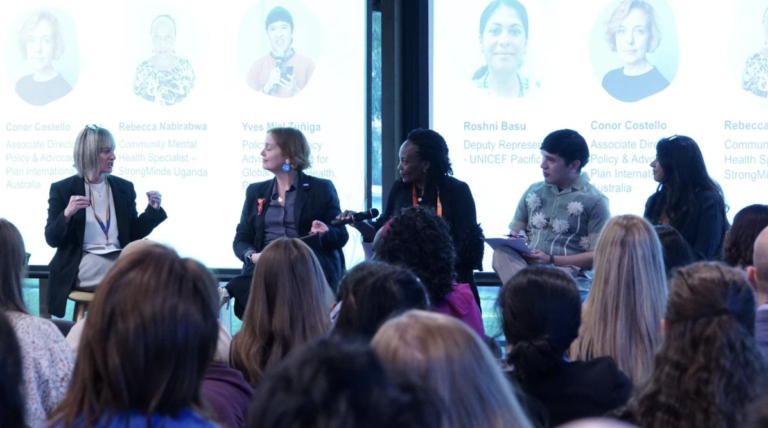
Panel session at the margins of Women Deliver 2026 and organised by Orygen with our own Yves Zuniga as one of the panellists.
What came through strongly was a simple but powerful truth: “Help sought” does not always equate to “help received.”
Across the world, many women, girls and gender-diverse young people are reaching out, but systems are not always meeting them where they are. This is not just about access; it is a design issue.
Needless to say, we must work with communities, not just for them. So that, together, we can shape services and how they are delivered in a way that reflects local realities, cultural norms, and context-specific needs. Because when we do that, services become more responsive, more trusted, and more effective.
Another message that stayed with me came from one of our long-standing partners, Lifeline International. Its CEO, Thilini Perera, stressed “When women and girls have safety, autonomy, economic security, and freedom from violence, their risk of suicide falls.” Beyond that, when they have real power to shape the systems meant to support them, those systems improve. They become more humane, more accountable and more impactful.
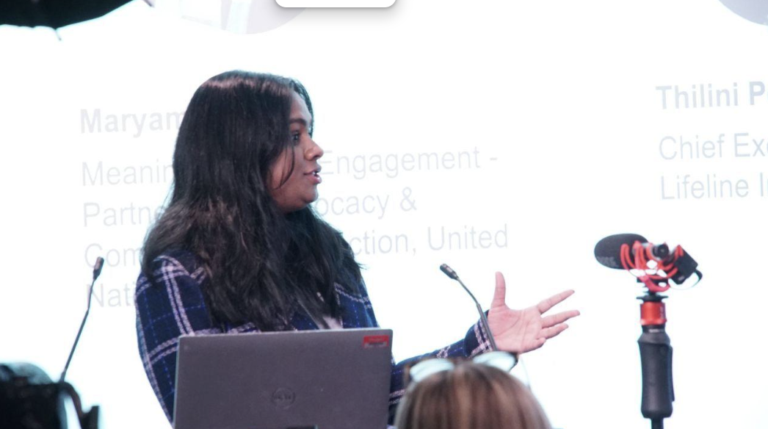
Thilini Perera, CEO of Lifeline International
Grounding the conversation and learning from practice
At a side-event led by StrongMinds, we shifted from discussion to experience. Participants were immersed as we witnessed how StrongMinds implements its six-week group interpersonal therapy model, used with women and girls across Africa and, in this case, Uganda. It was a powerful reminder that scalable, community-based mental health care already exists.
In that space, however, I underscored a concern that can no longer be ignored: mental health remains critically under-prioritised, both politically and financially. If we are serious about gender equality, this is no longer acceptable.
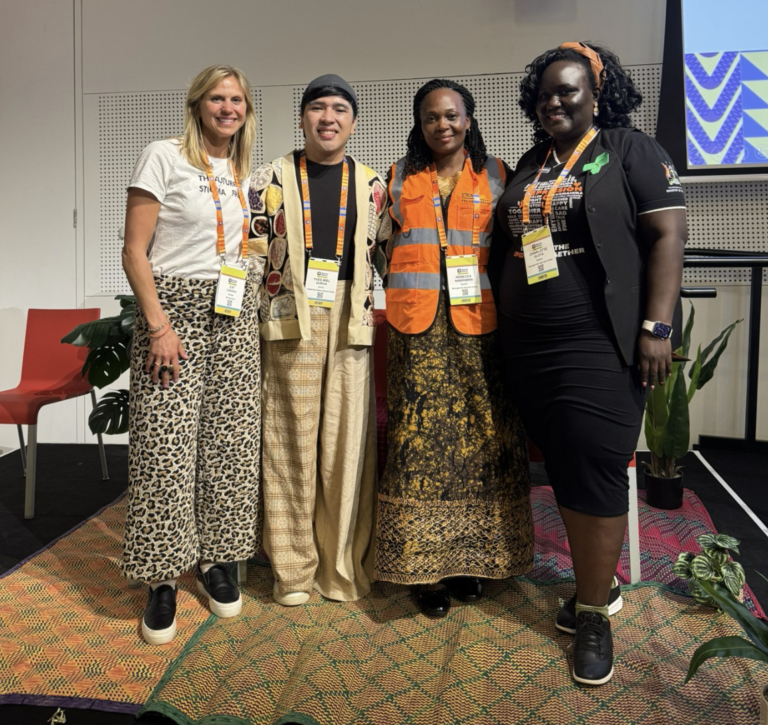
StrongMinds team leading a side event at Women Deliver 2026
Maternal mental health: a striking silence
And yet, across the conference, one issue remained largely under the surface: on a global stage dedicated to women’s health and rights, the relative silence surrounding maternal mental health is striking.
We know that mental health conditions are among the leading contributors to maternal morbidity. There is also evidence that untreated maternal mental health conditions affect child development, family wellbeing, and economic outcomes. But there is a silver lining: integrating maternal mental health care into primary health care is not just feasible but also cost-effective.
For now, though, maternal mental health is too often unbudgeted, underrepresented in policies and programmes, and missing from large-scale financing conversations. But this is not a lost cause. It is an opportunity.
Looking ahead: from side-events to system change
If there is one takeaway from Women Deliver 2026, it is this: mental health cannot remain at the margins. Not in the global declarations like the Melbourne Declaration. Not in financing for women and girls. Not in programme design meant to address both women’s physical and mental health.
As we look toward future convenings and commitments, including the outcomes from Melbourne, there are a few clear priorities. It is vital to:
- Ensure meaningful inclusion of mental health, including maternal mental health, in the Melbourne Declaration
- Elevate mental health from side-events to plenary-level discussions as a recognition of its urgency and importance
- Back commitments with financing, particularly through integrated primary health care approaches
- Continue putting young people and their lived experiences at the heart of shaping policies and programmes
A timely reminder for World Maternal Mental Health Day
As we mark World Maternal Mental Health Day, the message is simple: you cannot deliver for women and girls without delivering for their mental health.
What we need now is a concerted effort to put it in the spotlight, and generate the political will, and most importantly, investment required.
My week in Melbourne was a strong reminder of what is possible when global communities come together. Just as importantly, it’s a reminder of what remains unfinished. My first time at Women Deliver 2026 felt less like a milestone and more like a clear call to action.
Looking ahead, I hope we move past the question of where mental health fits. It should be exactly where it belongs… at the centre, alongside other crucial issues like human rights, gender justice, and economic empowerment. Not as a competing priority, but as part of advancing all the other causes we care about.
I also look forward to the day when we no longer need to advocate for a mental health champion in the room, because mental health is already recognised as a non-negotiable part of supporting women and girls everywhere.
Honestly speaking, there is still a long road ahead, but it is far from impossible. For now, we keep going, together and with purpose.
Happy World Maternal Mental Health Day everyone!
Maternal Mental Health is a Right, Not a Privilege
We’re supported by Bukhman Philanthropies to advocate for better mental health support for women during and after pregnancy.
Perinatal depression, anxiety, and other maternal mental health conditions affect up to 1 in 5 women globally.
Every mother deserves to survive and thrive. Yet, maternal mental health remains a neglected dimension of maternal and neonatal health in many low- and middle-income countries. This has consequences not only for mothers but also for infants’ survival, growth, and development.
We are working in close partnership with national governments and CSOs to improve and scale mental health care for mothers where it’s most urgently needed.
Together, we are calling for:
- Integration of mental health into existing maternal and child health services
- Access for all women, during pregnancy and after birth, to a primary and community care health professional trained in mental health care.
- Prioritising funding for essential maternal and child health services that include maternal mental health care.
If you want to learn more about our maternal mental health advocacy work, visit https://unitedgmh.org/maternal-mental-health/
Other resources:
A Right Not A Privilege: Prioritising Maternal Mental Health (2025)
Maternal Mental Health: A Right Not A Privilege – Our Voices
Perinatal Depression in Uganda: Supporting Recovery Through Community-Based Care