Why Mental Health Lived Experience Advocacy Matters
By Sarah Kline, October 13th 2026
As Sarah Kline, Co-Founder of UnitedGMH, prepares to step down, she reflects on why lived experience advocacy matters and what needs to happen next.
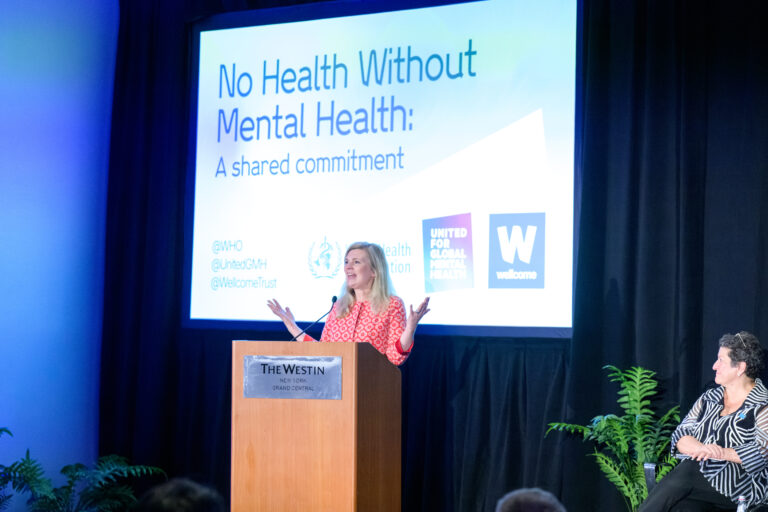
When I was asked to join United for Global Mental Health (UnitedGMH) to help set it up, I almost said no. I knew working on mental health would be hard and speaking about my experience would be a risk.
Because for those of us who live with a chronic mental health condition, having lived experience is not a club we ever wanted to be in or an identity we cultivate for our benefit. Quite the opposite. We don’t seek this role and this life experience. Talking about what we go through is draining. It leaves us tired and vulnerable. And without support, it can damage our mental health to share our experiences with others.
Lived Experiences belong in decision-making rooms
But I said yes to working on mental health because I was frustrated. Globally, more than 1 billion people live with a mental health condition. Yet it was still common to hear conversations where mental ill health was dismissed as not important or something you could just “get over.”
And in my work in global health, I saw conversations about mental health – particularly mental health in Low- and Middle-Income Countries (LMICs) – discussed in global meetings with few, if any, people with lived experience from those countries present.
This was wrong. As members of the Lancet Commission on Ending Stigma and Discrimination in Mental Health, we know all the evidence shows that to stop stigma, people need to hear directly from those with lived experience. And to understand how to support people’s mental health needs, we need the people with lived experience in the room to reform mental health support and help save lives.
The change that is possible
That’s why, as UnitedGMH, and through our creation of the Global Mental Health Action Network (GMHAN), we set out to make hearing from people with lived experience not just possible but expected in as many places as we could.
UnitedGMH is a global team (staff members and board) spanning over fifteen countries across four continents. Working closely with national mental health organisations, we have brought lived experience into policymaking. We have put mental health at the heart of discussions on climate change at COP, young people’s welfare at the UN, maternal health and raised new funds to tackle the mental health impacts of diseases like HIV/AIDS. We have supported work to decriminalise suicide in countries with millions of citizens.
Together with the membership of the GMHAN – over 11,000 members in 170+ countries – we are the leading voice of mental health advocacy and are supporting thousands of lived experience advocates to be heard. This year’s World Mental Health Day focus on lived experience is the clearest demonstration yet that the world is learning to listen to lived experience.
Looking ahead
But the real test is what happens next. Because among the most important issues to those of us with a mental health condition is the quality of the care we receive. And at the very heart of that is whether we will be treated with dignity and support, or with harsh punishment and confinement. It is exactly why we launched the “Care Not Custody” campaign: because while the voice of people in mental health institutions is least often heard, it is institutions that most need reform. We have partnered with WHO to make the case for reform.
So in my final days with UnitedGMH I salute each and every lived experience advocate who is brave enough to step up and speak out. Particularly in societies and cultures where to do so risks breaking with their families, struggling to find a job or a life partner. Courageous individuals are sharing their stories across social media and in rooms around the world during this month. I pay tribute to the incredible range of organisations supporting them, frequently started and run by people with lived experience themselves. And I deeply appreciate all those who have stepped up to fund this work: in a world with scarce funding for mental health, every dollar really counts.
Stepping down from UnitedGMH will give me a very welcome break from the pressure to share my experience. But it doesn’t mean I will stop doing it. Whenever you talk about mental health, just remember, it is not “those people over there” – we are right here in front of you.