Across Borders, Toward Care: Asia-Pacific Momentum for Maternal Mental Health
By
Annisa Fajriani, Maternal Mental Health Consultant & Yves Zuniga, Policy and Advocacy Advisor
On 24 to 25 June 2026, more than 140 participants from across 30 countries in Asia-Pacific region and beyond came together for UnitedGMH’s two-day workshop, Learning Across Borders: A Peer-to-Peer Exchange for Maternal Mental Health Advocacy in Asia-Pacific.
The workshop convened policymakers, civil society leaders, health professionals, researchers, development partners, advocates, and people with lived experience to strengthen regional advocacy, exchange practical lessons, and foster new partnerships. Across two days of enriching discussions, one message resonated throughout: maternal mental health is fundamental to the health and wellbeing of mothers, babies, families, and communities, and it must be a routine part of health systems, not an afterthought.
One strong area of consensus was that maternal mental health cannot remain separate from maternal, newborn, and primary health care. It must be part of routine antenatal and postnatal care, community health visits, and trusted services women already use. Clear examples of maternal mental health integration happening in Thailand, Indonesia, and Nepal showed what this can look like: mental health support delivered through midwives, community health workers, and other allied health professionals, defined care pathways strengthened through research and advocacy, and ultimately maternal mental health components integrated in primary care services.
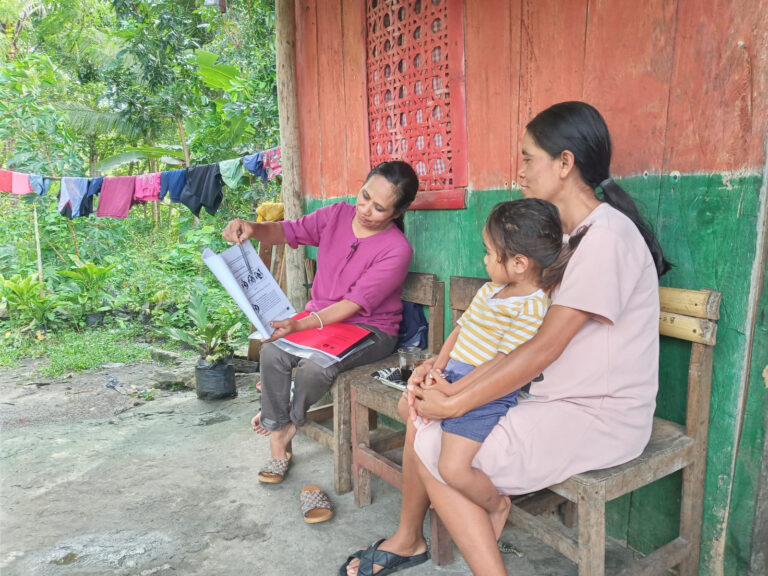
A community health worker conducts a home visit as part of the BUNDA Program, which integrates maternal mental health support into the existing community health system. Photo credit: Foundation for Mother and Child Health (FMCH) Indonesia.
Turning evidence into everyday care
The workshop also highlighted that many of the tools, evidence, and interventions needed to improve maternal mental health already exist. The challenge is no longer knowing what works, but ensuring these approaches are adapted to local contexts and delivered through the workforce that is available.
Task-sharing emerged as a key strategy, enabling midwives, community health workers, lay counsellors, and peer supporters to provide essential mental health support where specialist services remain scarce. At the same time, participants emphasised that task-sharing cannot simply mean shifting more responsibilities onto an already overstretched workforce. Sustainable integration requires investment in training, ongoing mentoring, supportive supervision, and the wellbeing of health workers themselves. Only by supporting those who provide care can we build programmes that are effective, trusted, and resilient over the long term.
“Maternal mental health must be integrated into routine health and community systems across the life course, including for adolescent mothers, ensuring early, stigma-free support. Investing in workforce capacity and multisectoral services is essential to reach women, adolescents, and families effectively across Asia-Pacific.” Ruth O’Connell, Mental Health and Psychosocial Support (MHPSS) Specialist, UNICEF’s Asia Pacific Office.
Making the investment case of maternal mental health integration
Untreated maternal mental health conditions carry costs far beyond the health sector, affecting child development, family wellbeing, learning, productivity, and economic participation. The case for action is strong, but advocacy must speak to the language and priorities of decision-makers. Maternal mental health should be framed not only as a clinical concern, but as an investment in human capital, early childhood development, gender equality, and resilient communities. In a tight funding environment, advocates need evidence, clear asks, and stories that show why action cannot wait.
The Asian Development Bank emphasised that investing in maternal mental health is an investment in healthier families, stronger economies, and sustainable development, with evidence suggesting that every US$1 invested can generate around US$5 in social and economic returns. Complementing this message, PAM Foundation Thailand shared country-specific evidence estimating that improving perinatal mental health could yield substantial economic gains, demonstrating how investment in maternal mental health delivers returns across sectors including health, education, and workforce participation.
Collaboration is the way forward
The workshop underscored the power of coalitions and storytelling in advancing maternal mental health advocacy. Lessons from partners across Africa demonstrated how coalitions can help move community-based and community-driven initiatives beyond short-term projects into sustainable public systems. They also reinforced that advocacy is most effective when organisations work collectively – sharing evidence, learning, and resources.
Over the course of the two-day workshop, participants explored the potential for an Asia-Pacific alliance on maternal mental health, global communities of practice, cross-country research, and shared advocacy tools.
Perhaps most importantly, the workshop reaffirmed that lived experience must remain at the heart of advocacy. We were deeply honored to be joined by mothers with lived experience, whose voices reminded us that while evidence can open doors, it is stories that reveal what is truly at stake.
United for Global Mental Health will continue working with partners to develop a practical advocacy toolbox to support the integration of maternal mental health into policies, programs and health systems across the Asia-Pacific region and beyond. Drawing on evidence, case studies, and lessons shared throughout the workshop, the toolbox will equip advocates with practical resources to strengthen policy engagements, shape advocacy priorities, and adapt successful approaches to their own country contexts.
More than a resource, the toolbox is intended to foster continued learning and collaboration among advocates across the region and beyond. Turning evidence into action will require sustained partnerships, shared leadership, and collective commitment. Together, we can help ensure that no mother has to navigate pregnancy, childbirth, or early parenthood without access to the mental health care and support she needs.
If you are interested in following more on maternal mental health, visit our dedicated maternal mental health page on our website. We will be updating it with new resources from Asia-Pacific. We would like to thank Bukhman Philanthropies for supporting this work.