How can COP31 unlock progress on climate action and protect global mental health?
By Alessandro Massazza, Senior Policy & Advocacy Advisor, United for Global Mental Health
Wednesday 4th November
This year, the Conference of the Parties (COP), the main UN conference on climate change, will take place for the 31st time in Antalya, Turkiye. COP31 will be co-chaired by Turkiye and Australia, with Australia keen on bringing in strong representation from Pacific voices at the forefront of the climate crisis.
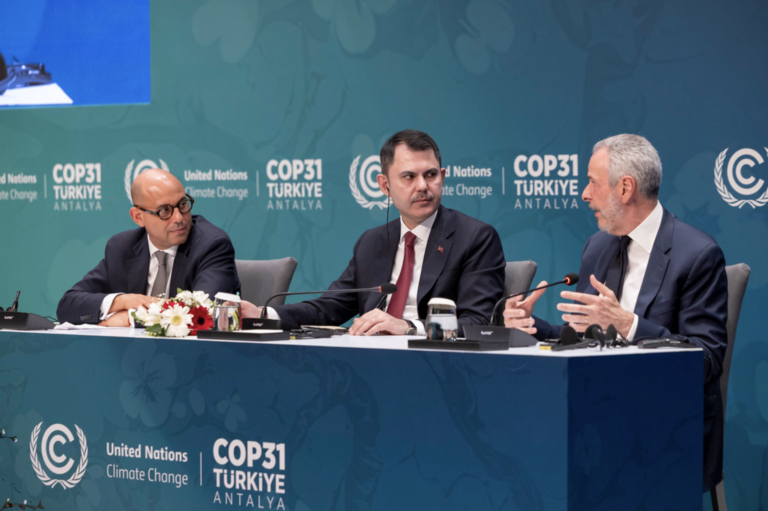
From left to right: Simon Stiell (Executive Director of the UNFCCC), Murat Kurum (COP31 President Designate) and André Corrêa do Lago (COP30 President Designate). Credit: UN Climate Change
All countries involved in the COP31 process are being heavily impacted by climate change. Whether its droughts and floods across Turkiye and Australia impacting the livelihood of farmers and agricultural workers or sea-level rise threatening houses and communities across the Pacific; climate impacts profoundly affect mental health in these regions. You can read more about these impacts in our photo-essay here.
How can progress at COP31 simultaneously lead to more ambitious climate action and protect the mental health of people and communities around the world? Below, we outline how some of the big ticket items to be discussed at COP have the potential to protect our planet while simultaneously safeguarding health. For a full description of how health policy asks from the climate and health community, please consult the Global Climate and Health Alliance set of policy recommendations.
The Global Stocktake
The Global Stocktake or GST, is a key mechanism under the Paris Agreement that is used to evaluate global progress towards achieving the Agreement’s long-term climate goals. It takes place every 5 years and this COP represents the start of the second round of the GST, or GST2. The findings from the GST are aimed at informing countries as they update and ramp up their national climate pledges, also known as their Nationally Determined Contributions or NDCs.
We are calling for physical and mental health considerations to be integrated across the GST process and for physical and mental health benefits to be considered as outcomes of all pillars of climate action, including mitigation, adaptation, and responding to loss and damage.
Adaptation
Adaptation is the one negotiating track where mental health features formally. This is because out of the 59 indicators (the Belém Adaptation Indicators (BAI) proposed as part of the Global Goal on Adaptation to measure global progress on climate adaptation, one is focused on mental health. More specifically, this indicator looks at the “proportion of the population vulnerable to climate change with access to mental health and psychosocial support”.
At COP31, countries will have to progress work on the Belém Adaptation Indicators by agreeing on the composition of a technical task force that will have to work on the methodologies and meta-data to allow for these indicators to be actually measured by countries.
However, perfectly operationalised adaptation indicators are likely to lead to little progress, if no finance is available to implement adaptation action. Therefore, one key priority for COP31 concerns following-up on the pledge to triple adaptation finance to at least US$ 120 billion well in advance of 2035. This will allow for national adaptation plans to be fully implemented and finance, therefore protecting the physical and mental health of communities around the world from the impacts of climate change.
Just transition
Just transitions away from fossil fuels that fail to protect physical and mental health are inherently unjust. At COP30, countries agreed on the establishment of a Just Transition Mechanism (JTM). The aim of the JTM is to better align and support policies and initiatives for a fair and inclusive climate transition.
Given that physical and mental health must be protected as we transition away from fossil fuels, it’s essential that health is included within the scope of the JST and that the protection of human health is established as a pre-requisite for a just transition. Practically, health experts should be included in any new just transition entities established to provide technical support, for example in the context of assessing the health impacts of different transition pathways.
Loss and damage
All around the world, people and communities are already experiencing the impacts of climate change on mental health, as shown by our case studies across Turkiye, Australia, and the Pacific. However, too often, the mental health impacts of climate change are not reflected in loss and damage assessments. Therefore, we encourage guidance to be developed on how to better integrate mental health impact assessments when reporting on loss and damage.
Importantly, assessments must be followed by adequate financing for responding and addressing these impacts. Therefore, countries should rapidly scale up new and additional grants-based finance for addressing loss and damage, including health-related loss and damage, in alignment with the recent International Court of Justice Advisory Opinion on the Obligations of States in respect to Climate Change. The Fund for Responding to Loss and Damage however, remains woefully under-funded, with less than 0.2% of the estimated baseline of US$ 400bn annual needed available in the fund as of September 2026.
Mental health will benefit from more ambitious climate action across many of the other negotiating streams including mitigation, finance, agriculture and gender. For a more detailed outline of the asks from the health community, please consult this policy brief by the Global Climate and Health Alliance.
What is happening outside of the negotiations for mental health?
Outside of the formal negotiations, different activities are taking place with a focus on health (for a full outline please consult the WHO page: Health at COP31). In particular:
- The Turkiye Presidency has identified “dynamic and resilient health systems” as one of the thematic pillars for the Action Agenda.
- A Ministerial will take place on Health Day, on the 9th of November. The last time a Health Ministerial took place at COP it was at COP28 and our analysis showed that only 14 out of the 55 ministerial interventions mentioned mental health. If you know your country will be attending, make sure to advocate with your Ministry of Health to make sure mental health is represented.
- The launch of a report on financing the Belém Health Action Plan, which was launched last year by Brazil together with the WHO. The Belém Health Action Plan includes several concrete recommendations on how mental health and psychosocial support should be integrated within climate adaptation. Identifying how to finance and support the implementation of the Plan therefore represents a key opportunity to protect the mental health of people and communities from the impacts of climate change.
- The Turkish Presidency will also launch a new initiative called the Antalya Initiative for Health Resilience (AIR). AIR aims to connect existing knowledge, country experience, technical expertise, financing, and innovation around a common framework for dynamic and resilient health systems. We hope AIR represents an opportunity for the mental health community to also come together and contribute examples on how mental health systems can be strengthened in the face of climate change.
We have been working as UGMH together with many partners, including the Global Mental Health Action Network COP31 Short-Term Action Group to make sure mental health is meaningfully integrated in climate discussions at COP31. Together with many partners, we have been able to contribute to a diverse programme of activities on mental health, including approximately 14 dedicated side events which can be accessed here.
We hope you will join us at COP31 and beyond to advocate for all climate policies to commit to ambitious climate action and to protecting the mental health of all from the impacts of climate change.
Credit: UN Climate Change | Lara Murillo