Are you still allowing performative sharing of people’s trauma?
By Antonis Kousoulis MD, DrPHDirector, Global Mental Health Action Network
October 6th 2026
For World Mental Health Day, Antonis Kousoulis argues that people with lived experience shouldn’t have to relive their trauma to be taken seriously. They should choose what they share and how much, and they should have a real say in the decisions that follow.
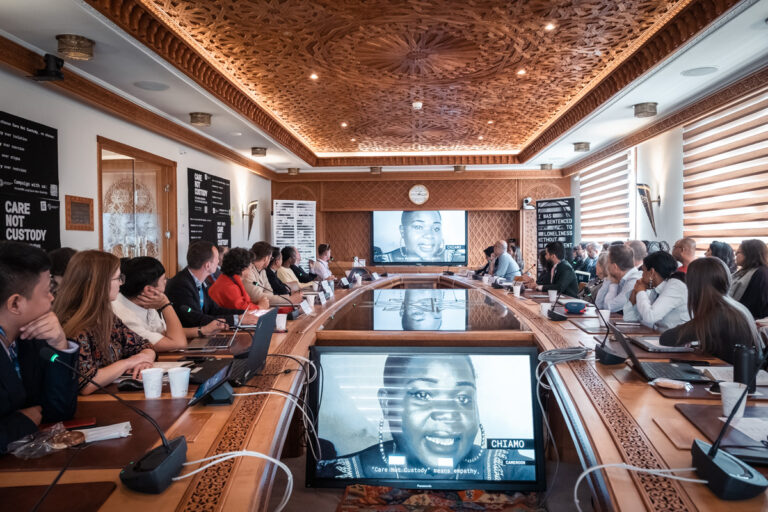
‘Care Not Custody’ campaign launch in Geneva, at the 2026 World Health Assembly.
People with personal experience of mental health problems are too often asked to share their most painful stories before their views are taken seriously.
When I am invited to a meeting as a “technical expert”, nobody asks me to start by walking the room through my CV, my key achievements or the experiences that qualify me to be there. My expertise is assumed from the moment I join, and I am simply expected to contribute.
But when someone is invited as a person with lived experience, they are still, far too often, asked to open with the most painful chapters of their lives, as if a performative sharing of their suffering were the entry fee for being taken seriously.
If we are serious about involving people with lived experience in our work, then one of the simplest actions we can take is to stop asking them to justify their experience.
At GMHAN, we generally do not ask people to disclose their lived experience, and we make no assumptions about who in a room or a Working Group does or does not have it. People decide for themselves what to share, when, with whom and in how much detail. Some of our advocates draw openly on their own experience; others contribute from it without ever naming it, and both are equally valid.
This only works if the spaces themselves are built on psychological safety and a trauma-informed approach, so that the choice to speak about oneself stays with the person rather than the institution.
The theme of this year’s World Mental Health Day is “Lived Experiences Heard: Real Voices, Real Change”, and hearing people should never depend on them first proving their pain.
Antonis Kousoulis MD, DrPHDirector, Global Mental Health Action Network