The new WHO DI Guidelines: how allies can get involved
By Ali Hasnain, October 9th 2026
Ahead of World Mental Health Day, Ali, UnitedGMH’s lead on deinstitutionalisation, explains why moving people out of institutions and into community care is one of the most important steps in global mental health reform.
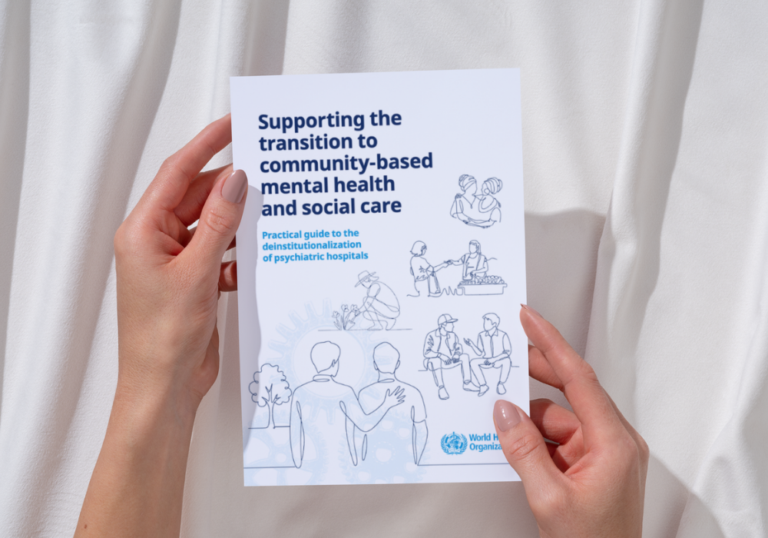
Today, the World Health Organization (WHO) has launched its first guidance on deinstitutionalisation, known as the DI Guide.
Deinstitutionalisation (DI) means shifting mental health care away from large institutions, such as psychiatric hospitals, and towards support that helps people live in their communities. It is arguably the most pressing mental health reform that almost nobody talks about.
Where the money goes
Around the world, psychiatric hospitals take up over half of all mental health spending. In many low- and middle-income countries, that rises to between 70% and 90%.
Institutional-style care can also exist outside hospitals. Some community-based settings, like large residential homes, end up working in much the same way. This is called trans-institutionalisation: the institution moves, but the model stays the same. These settings can also absorb a large share of funding.
The result is that very little is left for everything else: community services, youth mental health, suicide prevention, training and supporting the mental health workforce, digital innovation and more.
What people have lived through
The testimonies of people who have experienced institutionalisation are often hard to hear. Reports of human rights abuses are far too common. They include decades of involuntary confinement, coercion, being denied the right to make decisions about your own life, overmedication, and being cut off from family and community.
What the WHO is now recommending
The WHO’s guidance calls for a shift away from institutions towards a network of community-based care, with mental health built into the wider health system. It also calls for an end to long stays, coercion and involuntary treatment.
The guide sets out practical steps for how to plan, prepare and build these new systems. It recognises that every country starts from a different place, so it offers a menu of options that governments can adapt, whatever their resources. Its aim is for all care, wherever it is delivered, to:
- be based on human rights
- support recovery
- prevent long stays
- help people take part in community life
- use money more effectively
Built with people who have lived it
The WHO developed the guide with experts by experience of institutionalisation. Many are members of the Global Mental Health Action Network’s Expert by Experience Action Group (EEAG) on DI. They shared where the system is failing, what good care looks like, and how people can build a life in their community.
These experts are also at the heart of Care Not Custody, a new global campaign to help governments put the guidance into practice in every country. Watch the campaign video below:
How you can help
Neither the experts nor governments can do this alone. They need allies: policymakers, mental health professionals and workers, researchers, advocates and civil society organisations.
If you want to stand alongside experts by experience on DI, you can join the Allies of the EEAG by filling out this form.
You can also read the WHO’s DI Guide in full.