Several wins and one major setback for suicide decriminalisation at the World Health Assembly
By Shayni Geffen
Senior Officer – Policy & Advocacy (Rights)
It took seventy-seven years for the World Health Assembly to host its first side event dedicated to suicide prevention. That was last year. This year, there were three.
In these events, countries gathered to share diverse, life-saving strategies. Sri Lanka detailed how restrictions on highly hazardous pesticides are estimated to have saved more than 93,000 lives. Nepal spoke about establishing a national suicide registry to fix gaps in data accuracy. Meanwhile, Portugal’s message was definitive: “suicide prevention must be embedded within health systems, but cannot be confined to them.”
Alongside these diverse approaches, legal reform – including suicide decriminalisation – emerged as a vital, recurring theme. All three side events championed decriminalisation as a core strategy for prevention (not just as a legal formality). This was important because over 20 countries still criminalise suicide and this deters people from seeking the life-saving help they need.
Nigeria’s commitment, in particular, came through loud and clear.
“We are optimistic that within two years we will be able to decriminalise attempted suicide in Nigeria,” announced Dr. Tunde Ojo, National Mental Health Programme Coordinator at Nigeria’s Federal Ministry of Health.
His statement was met with a resounding round of applause. Dr. Ojo explained that Nigeria is actively drawing on lessons from other countries, learning both what works and what pitfalls to avoid.
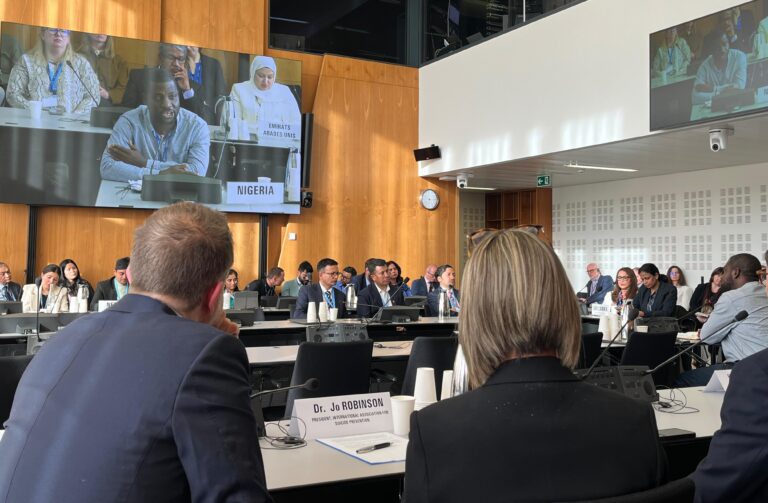
Dr Tunde Ojo, National Mental Health Programme Coordinator at Nigeria’s Federal Ministry of Health, speaking at the Official Side Event: A Global Pursuit of Suicide Prevention: Journey from Evidence to Action
This momentum carried straight into the official proceedings of the Assembly. Nigeria delivered an intervention underscoring ”towards compassionate health-based care” through suicide decriminalisation.
Unprecedently, twelve countries also used their floor time to highlight the urgency of strengthening health and social care systems to prevent suicide.
Visible Stories of Loss
Beyond the formal committee rooms and side events, the main courtyard of the Palais des Nations featured the Lost Screen Memorial, a public exhibition commemorating young people who had died by suicide.
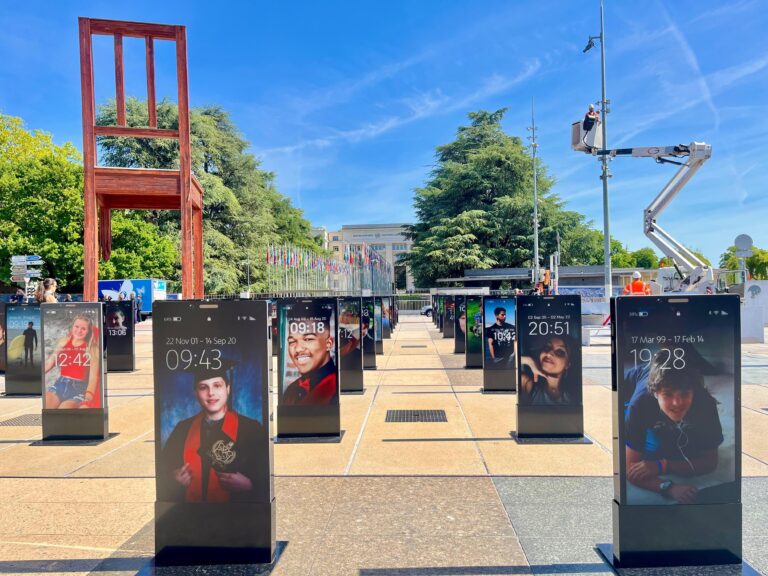
It was a historic moment: the first mass public awareness installation on suicide within a global policy space of this scale. It was impossible to walk past without stopping. Personal stories of loss are rarely made visible in these spaces. Even now, a month later, my mind keeps returning to the faces in those photographs.
A Heavy Counter-Current
Yet, against this backdrop of visible progress, a major setback emerged on the second day of the Assembly.
Pakistan’s Federal Shariat Court overturned the country’s hard-won suicide decriminalisation reforms through an act passed in 2022.
National advocates mobilised immediately, calling for urgent action. Earlier this week, a feature in a national newspaper published an analysis that “the absence of a clearly defined fixed punishment in foundational sources leaves space for legislative discretion guided by public welfare and harm prevention.” In short, the law can – and should – prioritise health over punishment. This is a critical legal battle to watch in the months ahead.
Looking Forward
Despite this regression, there are reasons to be optimistic. Political momentum is growing. Active reform processes are currently underway in Nigeria, Sierra Leone, Grenada, and several other countries.
If anything, the developments in Pakistan serve as a stark reminder: legal reform is not a static, one-time achievement. It is a continuous process that requires continuous political commitment, implementation,public awareness and monitoring.
This WHA was the year that countries finally spoke openly and bravely about suicide prevention and decriminalisation. Let next year be the year they report on tangible progress. By the time the next Assembly convenes, we should be hearing many more stories of countries rewriting their laws to ensure that people experiencing suicidal distress are met with a hand to hold, rather than a hand in cuffs.
Take Action
If you are interested in following more on suicide decriminalisation efforts, you can get involved by:
- Strengthening your advocacy: Our guide, Towards Care, Not Punishment: A Practical Guide for Advocates outlines proven strategies, media toolkits, and case studies to help you build successful decriminalisation campaigns.
- Joining our community: If you feel called to connect directly with other advocates passionate about suicide prevention through policy reform, consider joining the Suicide Prevention Working Group hosted by the Global Mental Health Action Network. The group meets monthly to collaborate, share insights, and discuss critical strategies.
- Learning more: Visit United for Global Mental Health’s dedicated platform on Suicide Decriminalisation to read country profiles and track ongoing legislative changes.