World Suicide Prevention Day 2026 Is Over. What Comes Next?
By Dr. David Johnson, Senior Officer, Policy & Advocacy, (Rights) and Muhammad Ali Hasnain, Policy & Advocacy Advisor
Every year, World Suicide Prevention Day (WSPD) creates an important moment for the world to focus its attention on suicide, the lives lost, the communities affected, and what we can collectively do to prevent it.
Advocates, parliamentarians, and partners around the world leveraged WSPD 2026 as an opportunity to call for a shift from punishment to care, not just to repeal laws, but to invest in suicide prevention at scale.
If we are honest, it takes a great deal of investment and perseverance to “Change the Narrative on Suicide”. This journey to change is further complicated by laws and policies in at least 24 countries, which criminalise suicide attempts. As detailed in the updated position paper by the International Association for Suicide Prevention, there is no credible evidence that criminalisation reduces suicide but plenty that it increases stigma, puts mental health professionals at risk, reduces help-seeking, disincentivises government action and inhibits accurate data collection.
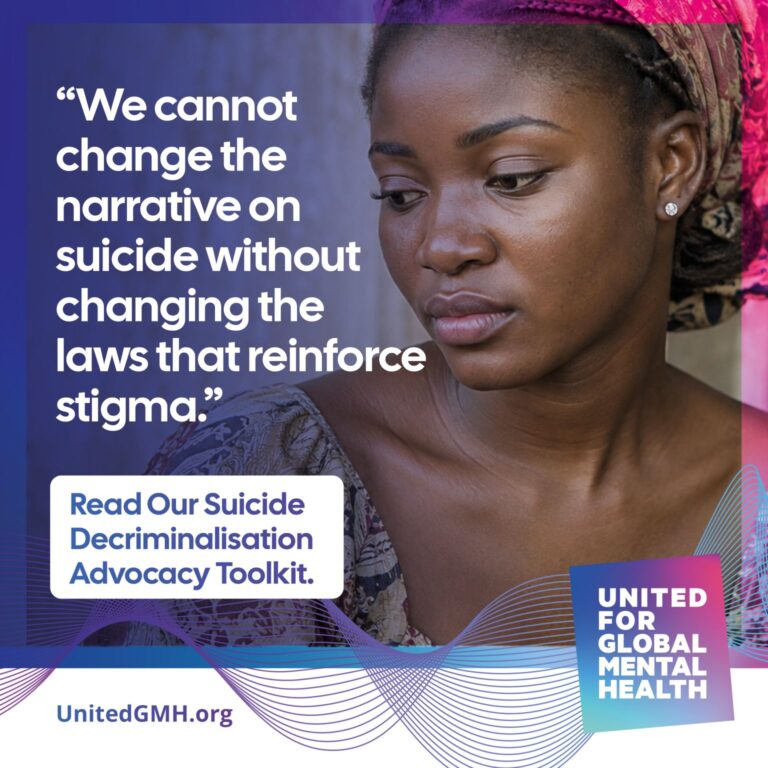
Championing Suicide Decriminalisation: A Practical Toolbox to Help
In this vein, we launched the Suicide Decriminalisation Advocacy Toolbox to help advocates advance legal reform. Inside, advocates can find tools to engage policymakers; build coalitions; shape public narratives; and learn from countries that have advanced decriminalisation.
Whether a country is beginning its decriminalisation journey or advocates are already working towards legislative change, this toolbox helps them take the next step.
Change Already Being Led At The National Level
The Advocacy Toolbox is important. But a toolbox cannot change a law. People do.
In Tanzania, Uganda, Grenada, Sierra Leone, and Nigeria, advocates are starting meaningful conversations and calling for legal reform that protects the rights and dignity of people experiencing crises. This, they say, is the critical shift that will ultimately save lives.
“Preventing suicide requires more than awareness. We need responsive mental health systems, early intervention, community support, and laws that prioritise life, treatment, dignity, and recovery over criminalisation. Decriminalising attempted suicide is a life-saving public health reform.”
Ameh Zion Abba, President, The Mandate Health Empowerment Initiative and Convener, Association of Mental Health Reform Organisations in Africa Network
Parliamentarians also have a role to play in this work. During the campaign, lawmakers from the UNITE Parliamentarians Network for Global Health highlighted the need to advance policies that ensure care instead of punishment.
“Breaking the silence on suicide requires more than awareness…As leaders, our responsibility is to create a society where seeking help is an act of strength, not a source of stigma.” Hon. Esther Matiko, MP (Tanzania)
The Missing Ingredient: Investment That Reaches Local Advocates
The biggest barrier that stymies suicide decriminalisation efforts is not an absence of ideas or a lack of public support. Rather, the most significant and often limiting factor is the absence of catalytic funding.
Ahead of WSPD, the Global Mental Health Action Network (GMHAN) asked its members, “What could an investment of $1,000 make possible?” More than 40 members across 10 countries responded. Their position was that relatively small, targeted investments could unlock immense potential through community outreach, research, training for service providers, and other advocacy activities.
We have seen in Singapore, Ghana, Guyana, and Malaysia how locally driven action can replace the criminalisation of suicide with suicide prevention policies and programmes. But progress elsewhere is being constrained by a fundamental resource gap. We join GMHAN in issuing a clarion call to donors to invest in local advocates, fund suicide prevention efforts, and help bridge the gap between advocacy and legal reform.
We are deeply grateful to our donor, Fondation d’Harcourt, for demonstrating what investing in this work can look like. Their support has helped us equip and amplify the voices of advocates like Mercy Gracy Omona, Coordinator of the Uganda Parliamentary Forum on Mental Health, who is opening dialogue with lawmakers to help them understand suicide prevention and their role in advancing change.
So, What Happens Next?
The attention generated by WSPD can be a catalyst for change. Here’s how you can help sustain it:
If you are a changemaker interested in driving this work, build your awareness by attending capacity-building sessions like the WHO African Region’s Mental Health Webinar Series. Join the GMHAN Suicide Prevention Working Group. Also, download the Suicide Decriminalisation Advocacy Toolbox to learn how your advocacy can actually change laws.
If you want to learn how you can partner with us or support this work, reach out to David Johnson at david@unitedgmh.org
Our vision for suicide prevention only becomes reality if we stay the course, amplify the right voices, and fund the work. Let’s decriminalise suicide worldwide together!